Paul O’Montis: The "Whispering" Voice the Nazis Tried to Silence

Updated: Sep 17
Today, I invite you to journey back to the vibrant and transgressive Berlin of the 1920s. This was an era where cabarets served as the epicentre of creative freedom. Here, Paul O’Montis shone brightly, embodying the spirit of the Weimar Republic. Tragically, Nazi barbarism cut his life short and attempted to erase his legacy.
From Siberian Camps to Berlin Stardom
Born Paul Emanuel Wendel in Budapest in 1894, his life was marked by movement from a young age. During World War I, while still a minor, he was interned in a camp in Siberia. It was there that he discovered his talent, entertaining fellow prisoners at the piano.
Upon his return to Germany, he adopted the stage name Paul O’Montis. His big break came in 1926 with Friedrich Hollaender’s revue Laterna Magica. O’Montis had a unique technique: a light tenor voice that was both elegant and ironic. This earned him the nickname "the whispering chansonnier."
Master of "Camp" and Recording Success
O’Montis was not just any singer; he was a master of parody and satire. With hits like "Was hast du für Gefühle, Moritz?" and "Die Susi bläst das Saxophon," he used suggestive lyrics and double entendres to challenge the gender norms of his time.
Visual Style: Always impeccable, he often appeared with a monocle and plucked eyebrows. His openly effeminate or "camp" aesthetic fascinated audiences in Berlin and Vienna.
Production: Between 1927 and 1933, he recorded nearly 70 records with the Odeon label. He became one of the most beloved stars of radio and cabaret, including performances at the legendary Eldorado club.
Persecution, Exile, and Tragedy
The Nazi rise to power in 1933 marked the immediate end of his career in Germany. As an openly gay man and a "degenerate" artist, O’Montis had to flee.
Vienna and Prague: He sought refuge in Austria and later Czechoslovakia, striving to keep his art alive as Europe darkened.
Arrest: Following the Nazi occupation of Prague, he was arrested in 1939. His journey through prisons in Zagreb and Łódź ended with his transfer to the Sachsenhausen concentration camp in May 1940.
A Legacy Recovered from Oblivion
For decades, O’Montis' figure was nearly erased from the official history of German cabaret. It wasn't until recent years that research by institutions like the Magnus Hirschfeld Foundation and biographies such as Ralf Jörg Raber's (Popular with Older Ladies and Young Men) rescued his memory. Today, his songs are playing once again, reminding us that while hate can silence a person, the wit and freedom captured on a shellac record can endure.
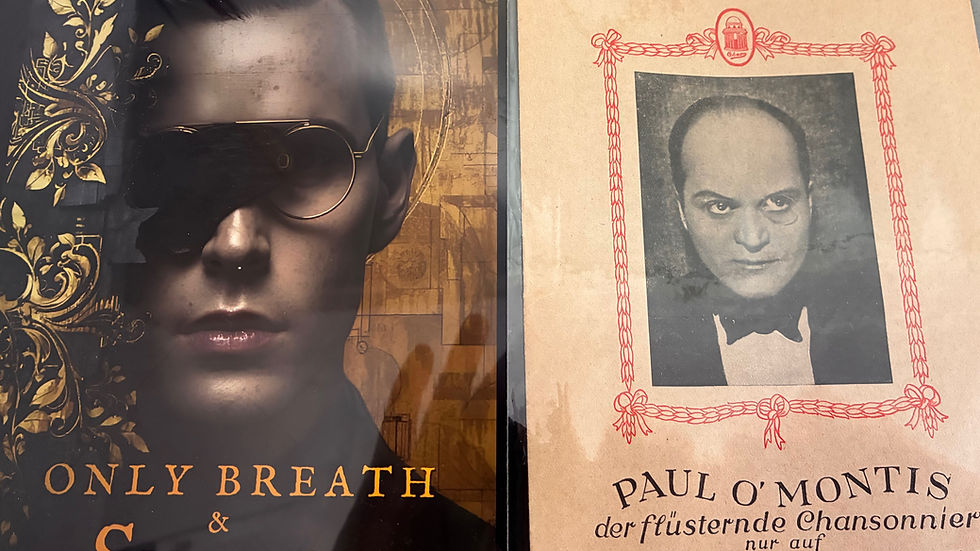
The Character in Only Breath & Shadow
The character of Paul O'Montis features in Only Breath & Shadow as a symbol of artistic defiance. Even as the Nazi shadow lengthens, Paul continues to perform provocative satire that openly mocks Adolf Hitler and the Nazi regime. He views these performances as a necessary act of protest against the occupation.
Target of Persecution
Because of his identity as a Jewish homosexual and his refusal to censor his satire, he is labelled a "degenerate" by Joseph Goebbels. His story within the novel highlights the systemic brutality directed at marginalized communities under Nazi rule.
Tragic Fate
His refusal to stop performing leads to his arrest in Prague in 1939. He is brutally interrogated before being convicted for his satire and "unnatural acts."
The Enduring Impact of Paul O'Montis
Paul O'Montis's life and legacy serve as a poignant reminder of the power of art in the face of oppression. His story is not merely one of tragedy but also of resilience. In an era where many voices were silenced, his remains a testament to the enduring spirit of creativity and defiance.
As I reflect on his journey, I am reminded of the importance of preserving such stories. They remind us of the past and inspire us to champion freedom of expression today. In a world where art can still provoke thought and challenge the status quo, O'Montis's legacy continues to resonate.
Let us celebrate the artists who dare to speak their truth, even in the darkest of times. Their voices, like that of Paul O'Montis, remind us that creativity can never truly be extinguished.
In conclusion, the life of Paul O'Montis is a powerful narrative woven into the fabric of history. It is a story that deserves to be told and retold, ensuring that we never forget the artists who dared to whisper their truths, even when the world sought to silence them.


Comments